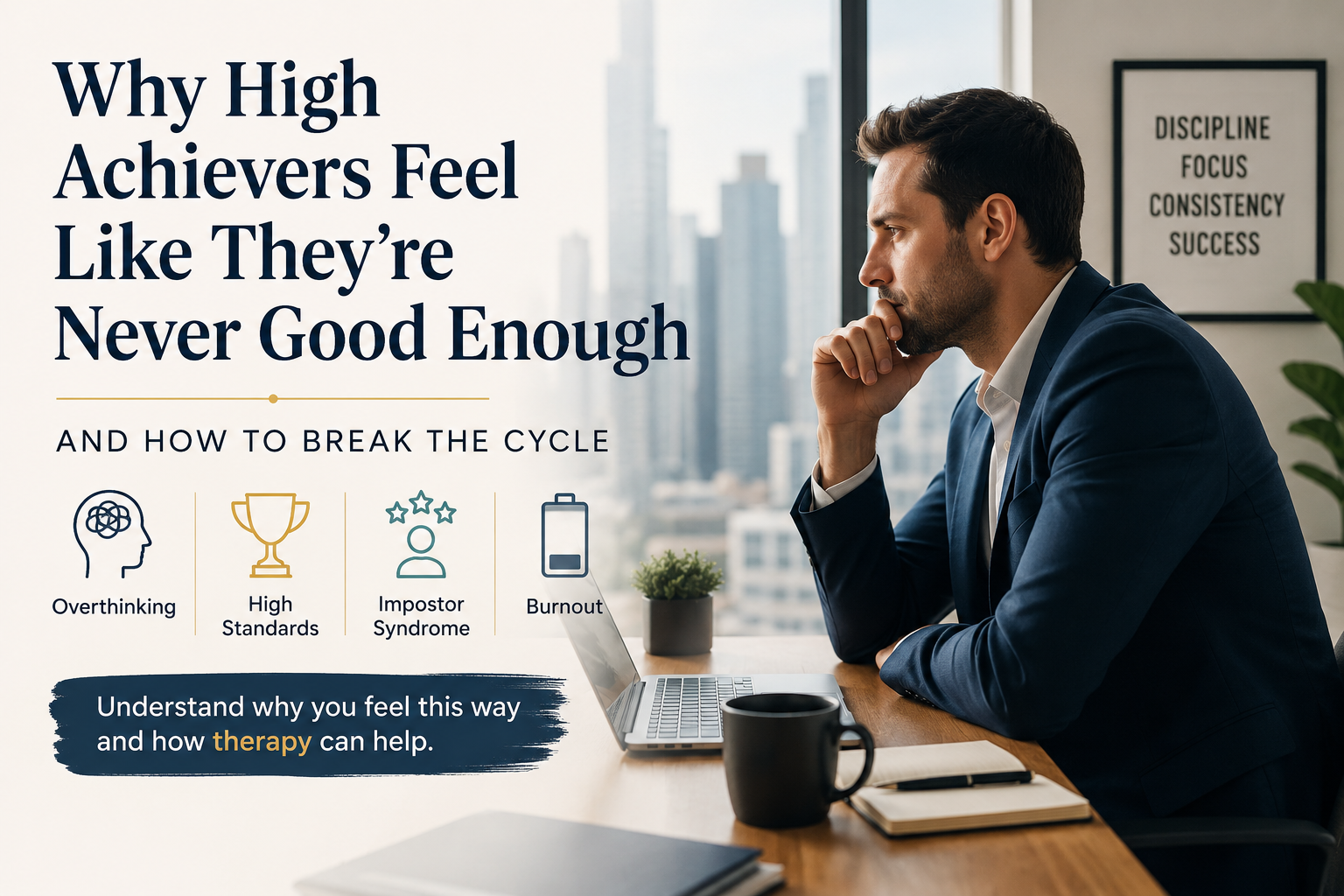
From the outside, your life looks successful.
You have a respected career. You’re dependable. You work hard, achieve your goals, and others admire your accomplishments. Yet despite everything you’ve achieved, you can’t shake the feeling that you’re somehow falling behind or not doing enough.
If this sounds familiar, you’re not alone.
As a therapist, I often work with high achieving professionals who appear calm, confident, and successful on the outside but privately struggle with anxiety, self doubt, perfectionism, and constant pressure to perform. The irony is that the very qualities that helped you succeed may also be preventing you from enjoying that success.
Success Doesn’t Silence Self Doubt
Many people assume confidence naturally comes with achievement.
Unfortunately, that’s often not the case.
Instead of celebrating a promotion, you may immediately wonder whether you’re qualified enough. After reaching one goal, your attention quickly shifts to the next. Compliments are dismissed, mistakes are magnified, and resting can feel uncomfortable because there’s always something more you could be doing.
For many high achievers, self worth quietly becomes tied to productivity.
If you’re not accomplishing something, you may begin to question your value.
Why High Achievers Feel This Way
Several psychological patterns commonly contribute to this cycle.
Perfectionism
Perfectionism isn’t simply wanting to do your best. It’s believing that anything less than perfect isn’t good enough.
You may spend hours overthinking decisions, replay conversations, or criticizing yourself for minor mistakes that others never noticed.
Impostor Syndrome
Despite years of education, experience, and accomplishments, many successful professionals worry they’ll eventually be “found out.”
Rather than seeing success as evidence of their abilities, they often attribute it to luck, timing, or working harder than everyone else.
Chronic Anxiety
Anxiety doesn’t always look like panic attacks.
It often appears as:
- Constant overthinking
- Difficulty relaxing
- Trouble sleeping
- Feeling guilty while resting
- Always planning for the next problem
- Difficulty being present with family and friends
Because these patterns become normal, many people don’t realize anxiety is driving their lives.
The Hidden Cost of Always Striving
While ambition can be incredibly rewarding, constantly chasing the next milestone comes with consequences.
Many high achievers experience:
- Burnout
- Emotional exhaustion
- Relationship difficulties
- Difficulty enjoying vacations or downtime
- Feeling disconnected from themselves
- Physical symptoms such as headaches, muscle tension, digestive issues, or chronic fatigue
Ironically, the success you’ve worked so hard to achieve can begin to feel empty because your mind never allows you to experience it.
Breaking the Cycle
The goal isn’t to become less ambitious.
It’s to become less controlled by fear.
Therapy can help you identify the beliefs that keep you trapped in the cycle of achievement and self criticism while developing healthier ways of measuring success.
Together, we can work on:
- Reducing anxiety and overthinking
- Challenging perfectionistic thinking
- Building genuine self confidence
- Creating healthier work life boundaries
- Improving relationships
- Learning how to enjoy success instead of constantly chasing the next achievement
You don’t have to choose between being successful and being happy.
It’s possible to continue pursuing your goals while also developing greater peace, balance, and fulfillment.
You Don’t Have to Carry It Alone
If you’ve spent years feeling like you’re never quite enough despite everything you’ve accomplished, therapy can help you understand why and begin creating lasting change.
You deserve to experience the same compassion, patience, and understanding that you so freely offer others.
Success should enhance your life, not become the reason you never feel good enough.
About the Author
Christopher Ryan McCarthy, LCSW, is a licensed psychotherapist providing secure telehealth therapy to clients throughout New York, New Jersey, Connecticut, California, and Florida. He specializes in helping high achieving professionals, healthcare providers, entrepreneurs, couples, and individuals overcome anxiety, perfectionism, trauma, relationship challenges, burnout, and life transitions using evidence based approaches including CBT, DBT, ACT, EMDR, mindfulness, and other integrative therapies. His goal is to help clients build resilience, improve emotional wellbeing, and create lasting, meaningful change.