
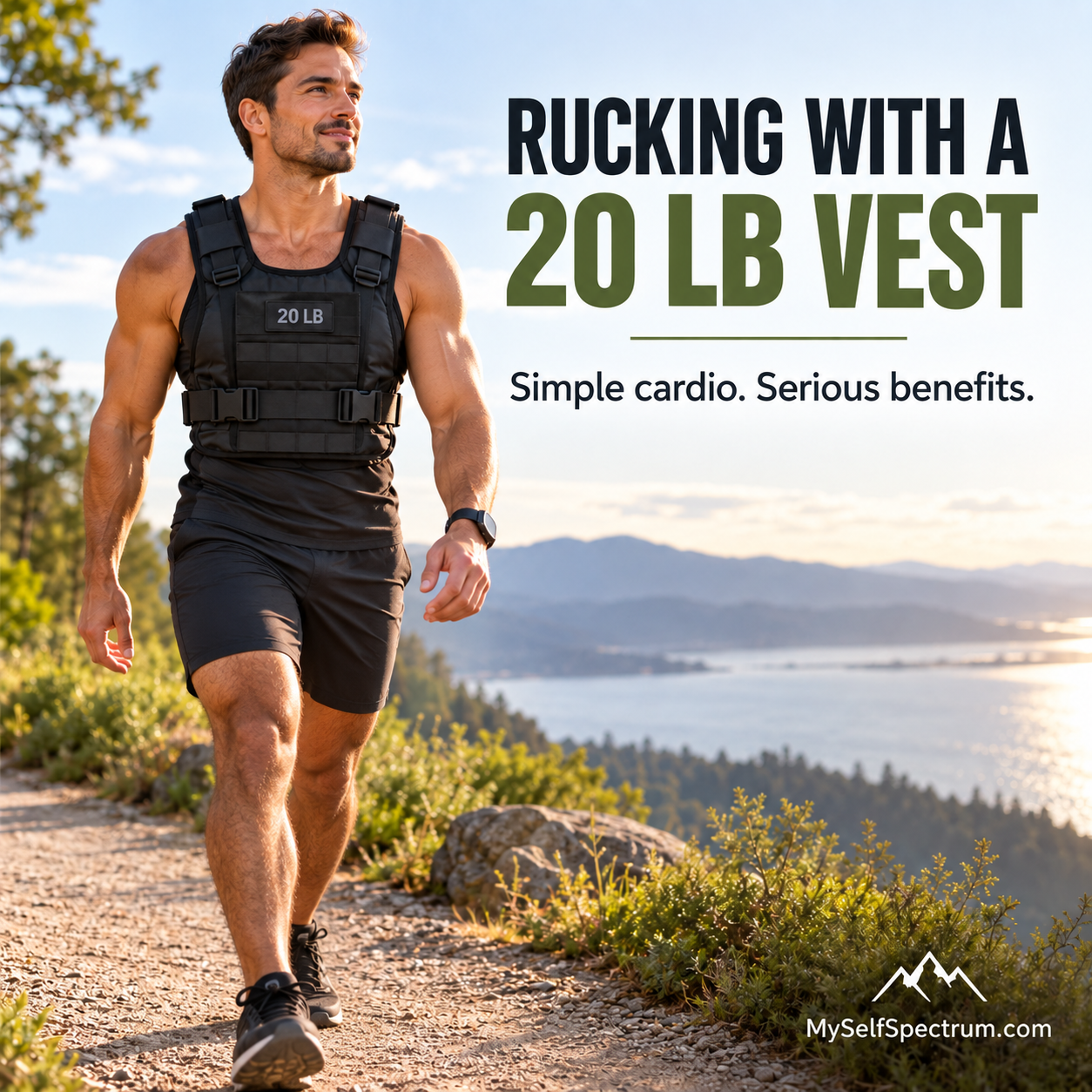
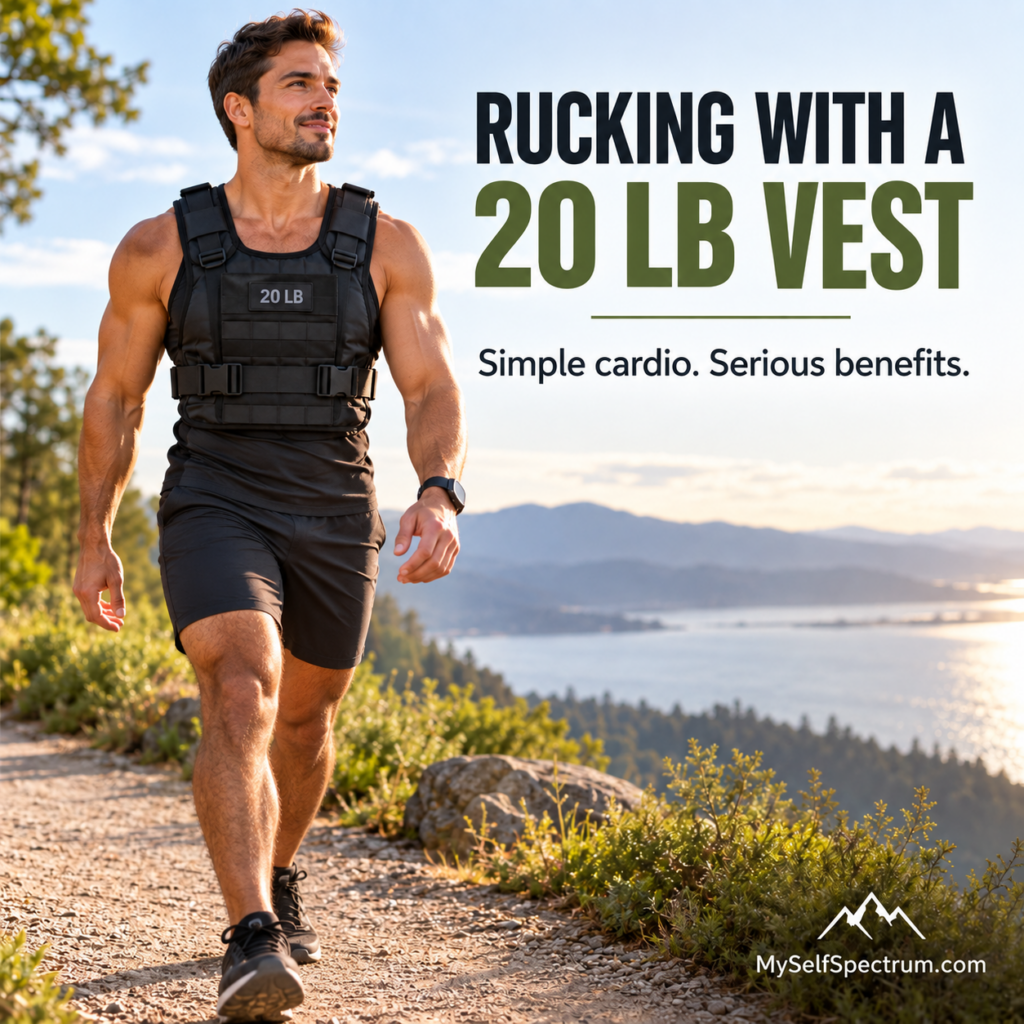
Rucking is one of the simplest ways to make walking more challenging. At its core, it means walking while carrying additional weight, usually in a backpack or weighted vest. I use a 20 lb weighted vest, which adds enough resistance to make an ordinary walk feel significantly more demanding without turning it into an overly complicated workout.
One of the biggest benefits of rucking is that it sits somewhere between regular walking and more intense cardiovascular exercise. You are still moving at a controlled pace, but the added weight increases the demand on your legs, core, posture, and cardiovascular system.
That can make rucking a useful option on days when you want more than a casual walk but do not necessarily want another hard run or high-intensity workout. It is a simple way to increase the challenge while still keeping the movement relatively straightforward.
The added load also means your body has to work harder to stabilize itself while you move. Your trunk, hips, legs, and postural muscles all have to manage the extra resistance, which can make rucking feel more like functional conditioning than ordinary walking.
For me, a 20 lb vest creates a good balance between challenge and practicality. It makes a short walk feel more purposeful while still allowing me to keep my stride natural and my movement controlled.
Posture matters. The goal is not to lean excessively forward or let the weight pull you out of position. I try to keep my chest up, core engaged, stride comfortable, and movements steady.
Rucking can also make shorter walks more efficient. A 10- or 15-minute weighted walk can feel significantly more demanding than the same walk without added resistance, which makes it useful on busy days when you still want to get meaningful movement in.
It can also fit well into a larger fitness and longevity routine. Strength training helps preserve muscle and functional capacity. Running and other forms of cardio can help build endurance. Rucking adds another layer by combining walking with load.
The key is progression. More weight is not automatically better. If you are new to rucking, starting with a lighter load and gradually increasing the challenge is usually the smarter approach. Your feet, joints, muscles, and connective tissues need time to adapt.
Speed does not need to be extreme either. A brisk, controlled walk can be enough to make the added weight meaningful. The goal is consistency, not trying to turn every session into a competition.
Recovery still matters. Even though rucking may feel easier than running, the added weight increases the overall physical demand. If you start noticing excessive fatigue, joint discomfort, foot pain, or back strain, reducing the weight, duration, or frequency may be appropriate.
One of the things I like most about rucking is how simple it is. You do not need complicated equipment, a detailed program, or a gym. Put on the vest, go for a walk, and let the added resistance increase the challenge.
Sometimes the most useful fitness strategies are still the basics. Walk. Carry weight. Move with control. Progress gradually. Let consistency create the adaptation.
Want to try rucking with a weighted vest?
This is the 20 lb weighted vest I use:
https://link.amazon/B06ij1vRq
For more health, longevity, and wellness content, visit MySelfSpectrum.com.
This post may contain affiliate links. I may earn a commission at no additional cost to you.


