For many gay men, being desired can start to feel like proof that we matter.
A match on a dating app. Someone checking us out at the gym. A compliment about our body. A hookup with someone we find attractive. More followers. More attention. More messages.
None of these things are inherently bad. It feels good to be wanted. The problem begins when being wanted becomes one of the primary ways we determine whether we are worthy.
For some gay men, this connection between desirability and self-worth begins long before dating apps ever enter the picture.
Growing up gay can mean spending important developmental years wondering whether you will be accepted. You may learn to monitor yourself closely: how you look, how you act, how masculine or feminine you appear, whether other people approve of you, and whether revealing your authentic self could lead to rejection.
Even after coming out, that need for acceptance doesn’t necessarily disappear. Sometimes it simply changes forms.
Instead of asking, “Will people accept that I’m gay?” the question can eventually become, “Am I attractive enough to be wanted?”
And gay culture can provide an endless supply of ways to measure ourselves.
Am I muscular enough?
Young enough?
Successful enough?
Masculine enough?
Sexual enough?
Interesting enough?
Do enough people want me?
Dating apps can intensify this dramatically because they transform human attraction into something that feels measurable. Messages, taps, matches, blocks, responses, and rejection provide instant feedback.
When someone attractive messages you, you may get a temporary boost in confidence.
When someone ignores you, suddenly you may question yourself.
The dangerous part is how quickly the brain can turn someone else’s preference into a judgment about your value.
“He didn’t respond” becomes “I’m not attractive.”
“He chose someone else” becomes “I’m not good enough.”
“I’m getting older” becomes “Nobody is going to want me.”
But none of those conclusions necessarily follow from what actually happened.
Someone not being attracted to you simply means that particular person wasn’t attracted to you. Attraction is extraordinarily subjective. It is not an objective ranking system for human worth.
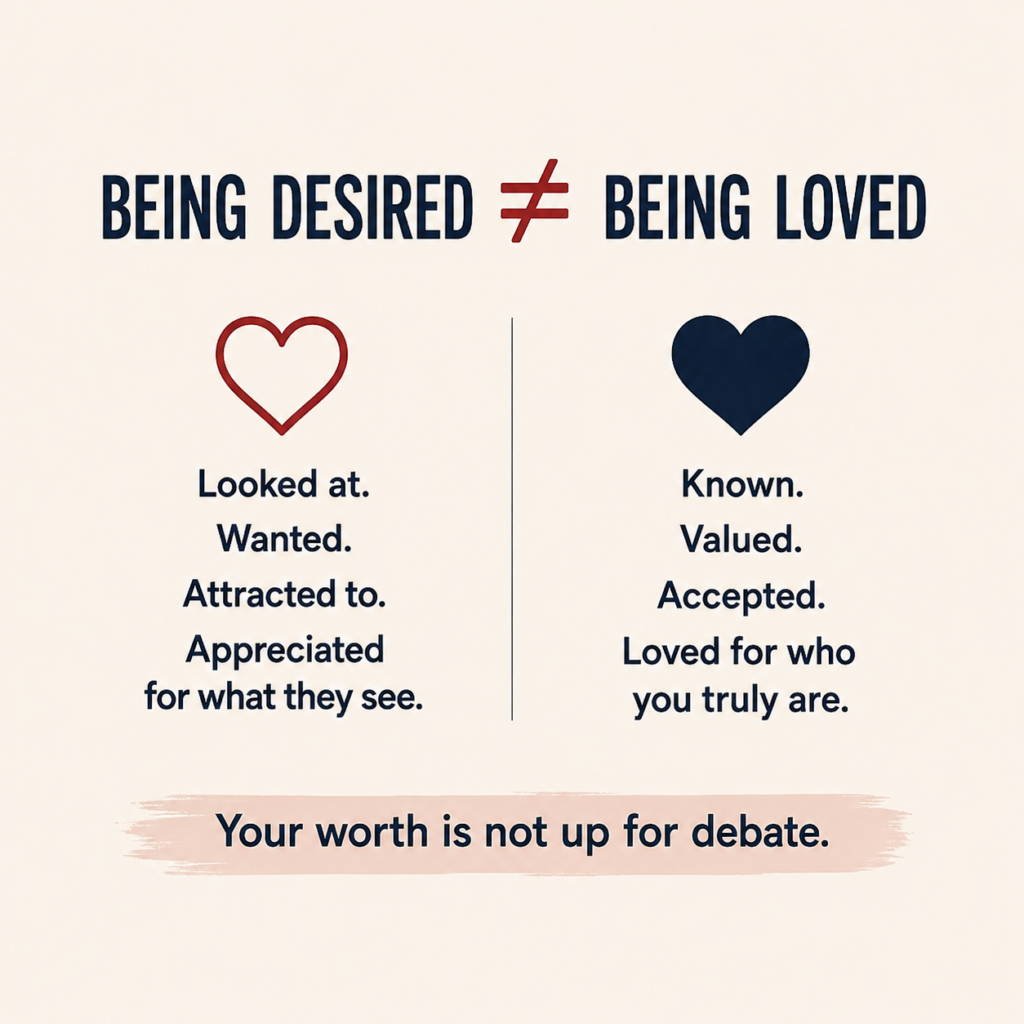
More importantly, being desired and being loved are two completely different experiences.
Someone can desperately want your body and have absolutely no ability to care for you emotionally.
Someone can think you’re incredibly attractive and still be incapable of communicating, respecting boundaries, showing empathy, or maintaining a healthy relationship.
Sexual attention can create the feeling of intimacy without necessarily providing any intimacy at all.
Love requires something deeper.
It requires vulnerability.
Consistency.
Emotional safety.
Respect.
Compassion.
Trust.
The willingness to truly know another person rather than simply consume an image of them.
And this distinction becomes incredibly important when your self-esteem has become dependent on external validation.
If you need other people to continually confirm that you’re attractive, rejection becomes much more threatening than it needs to be.
You may obsess over why someone stopped responding.
You may repeatedly check dating apps.
You may compare yourself to other men.
You may become intensely focused on your body or appearance.
You may remain in unhealthy relationships because being chosen feels better than being alone.
You may even pursue people you don’t particularly like simply because their attraction toward you makes you feel valuable.
At that point, you’re no longer simply enjoying attention.
You’re using attention to regulate your self-worth.
And external validation has one enormous problem: you cannot control it.
No matter how attractive, successful, fit, funny, or accomplished you become, there will always be people who aren’t interested in you.
That isn’t failure.
That’s being human.
The psychological goal, therefore, shouldn’t be to become so desirable that nobody ever rejects you.
That’s impossible.
The goal is to become secure enough that rejection doesn’t define you.
That doesn’t mean rejection will suddenly feel wonderful. Rejection hurts. Losing someone hurts. Feeling excluded hurts.
Security simply means that you can experience those feelings without turning them into evidence that something is fundamentally wrong with you.
Instead of thinking, “He rejected me because I’m not good enough,” you can learn to think, “I’m disappointed because I wanted this connection, but this person’s decision doesn’t determine my value.”
That difference may seem small, but psychologically it is enormous.
One of the best questions you can begin asking yourself is:
Who am I when nobody is validating me?
What qualities do you value about yourself that have nothing to do with your appearance?
Are you compassionate?
Curious?
Loyal?
Creative?
Funny?
Adventurous?
Resilient?
A good friend?
Someone who tries to make the world a little better?
Those parts of you cannot be measured by how many people swipe right.
Another useful question is:
Do I actually want this person, or do I want this person to want me?
Those are not always the same thing.
Sometimes we chase people because their attention feels like confirmation that we have achieved something. Their desirability seems to increase ours.
But healthy relationships aren’t trophies.
The person you choose should be someone whose presence makes your life richer, safer, more interesting, and more connected—not simply someone whose approval temporarily makes you feel better about yourself.
There is nothing wrong with enjoying being attractive. There is nothing wrong with the gym, fashion, sex, dating apps, hookups, or wanting other people to find you desirable.
The goal isn’t to reject any of those things.
The goal is to put them in their proper place.
Being desired can be enjoyable.
Being loved can be transformative.
But knowing your worth even when neither is happening is freedom.
And perhaps that is one of the most important forms of emotional security we can develop.
You do not need everyone to choose you.
You need to stop interpreting the people who don’t choose you as evidence that you shouldn’t choose yourself.
For more mental health tools, resources, and support, visit MyselfSpectrum.com.