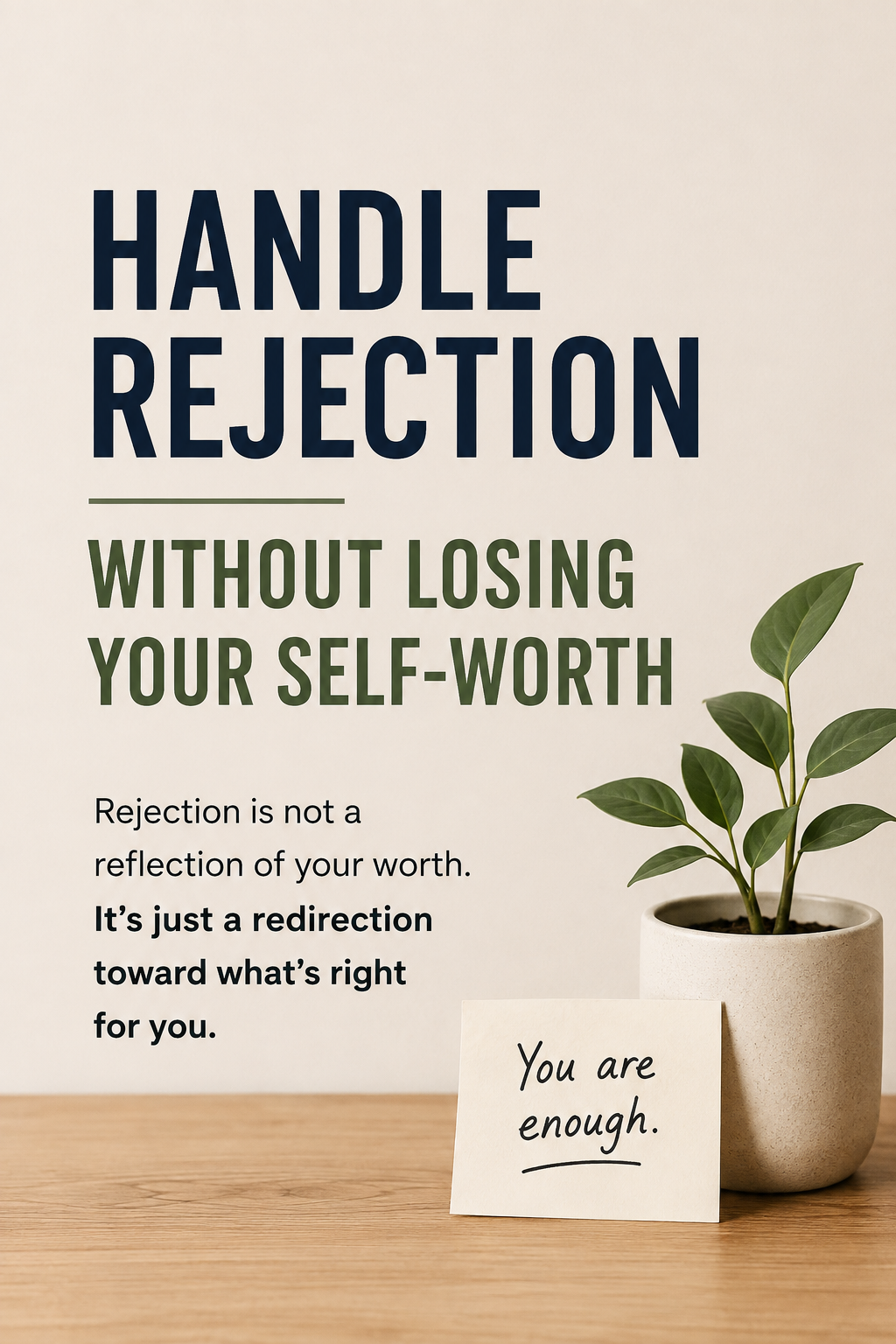

Rejection hurts. Whether it comes from dating, relationships, friendships, work, family, or social situations, being rejected can trigger a surprisingly intense emotional response. Sometimes the rejection itself is painful. Other times, what hurts even more is the meaning we attach to it. Someone doesn’t text back. A relationship ends. You don’t get invited. You’re passed over for an opportunity. Someone chooses somebody else. And almost immediately, the mind starts trying to explain why: “I’m not attractive enough,” “I’m not interesting enough,” “I’m not good enough,” or “Nobody really wants me.” That is where rejection often becomes much more painful than it needs to be.
One of the most important things to understand about rejection is that it tells you something about a particular situation. It does not necessarily tell you anything meaningful about your overall worth. Someone not wanting a second date does not prove that you are undesirable. A person ending a relationship does not mean you are incapable of being loved. Not getting a job does not mean you are incompetent. Being excluded from one social situation does not mean nobody values your friendship. The problem is that our brains often generalize. One negative experience becomes evidence for a much bigger story about ourselves. Instead of thinking, “That person wasn’t interested,” we think, “People aren’t interested in me.” Instead of thinking, “I didn’t get this opportunity,” we think, “I always fail.” Those conclusions feel convincing because they are emotionally charged, but feelings are not always accurate interpretations of reality.
Rejection can activate some of our deepest fears: the fear of not being enough, the fear of being abandoned, the fear of being alone, and the fear that other people are somehow more valuable than we are. If you already struggle with self-esteem, rejection can feel like confirmation of something you secretly worry is true. That is why two people can experience the exact same rejection and respond completely differently. One person may think, “That’s disappointing, but we probably weren’t a good match.” Another may spend days analyzing every interaction and wondering what is wrong with them. The difference is often not the rejection itself. It is the story each person tells themselves afterward.
This is especially important in dating. Attraction is incredibly subjective. One person may find you extremely attractive while another person feels no chemistry at all. Neither response defines you objectively. People have preferences based on appearance, personality, lifestyle, timing, emotional availability, values, sexuality, relationship goals, and countless other factors. Someone choosing another person does not automatically mean that person is “better” than you. It may simply mean they were a better fit for that particular individual. When you understand that compatibility is different from worth, rejection becomes easier to process.
After rejection, anxiety often fills in the blanks. “He didn’t respond because I embarrassed myself.” “She ended things because I’m boring.” “They didn’t invite me because nobody likes me.” Maybe, but maybe not. A useful question to ask yourself is, “What do I actually know to be true?” You may know that someone stopped responding. You probably do not know every reason why. You may know that someone chose not to continue dating you. You probably do not know that this means you are unattractive, unlovable, or destined to be alone. Learning to separate facts from interpretations is one of the most powerful ways to reduce the emotional intensity of rejection.
Handling rejection well does not mean pretending you do not care. You are allowed to feel disappointed. You are allowed to feel sad. You are allowed to wish things had turned out differently. Trying to immediately suppress those emotions can sometimes make them stronger. Instead, acknowledge what happened. “This hurts because I really wanted this.” “I feel embarrassed.” “I feel disappointed.” “I feel lonely right now.” Those emotions are valid. But there is an important difference between saying, “I feel rejected,” and saying, “I am rejectable.” One describes an experience. The other turns that experience into an identity.
After rejection, people also often replay the situation repeatedly. What did I say? Should I have acted differently? Was I too interested? Not interested enough? Did I text too quickly? Did I say something wrong? A little reflection can be useful. Constant analysis usually is not. Eventually, rumination stops being problem-solving and becomes emotional self-punishment. If you notice yourself replaying the same situation over and over, ask yourself, “Am I learning something new, or am I simply hurting myself with the same thoughts again?” If there is a lesson to learn, take it. Then let the situation end.
One of the most tempting responses to rejection is trying to reverse it. You may want to send another message, explain yourself, become more attractive, show them what they are missing, or try to get their attention again. Sometimes that urge is less about genuinely wanting the person and more about wanting to repair the damage to your ego. Ask yourself, “Do I actually want this person, or do I want them to want me?” That distinction matters. Your self-worth should not depend on convincing someone who rejected you to change their mind.
Rejection is uncomfortable, but it can also redirect you. The relationship that ended may eventually make room for a healthier one. The opportunity you did not receive may push you toward something better suited to you. The person who was emotionally unavailable may save you months or years of frustration by walking away early. You will not always immediately understand why something did not work out, but rejection often gives you information. It tells you where the fit was wrong. It tells you what someone else was capable of offering. Sometimes it shows you where you may need to grow. And sometimes it simply tells you to keep moving.
Rejection becomes much more powerful when your identity depends heavily on external validation. If your confidence comes primarily from being attractive, successful, popular, wanted, or admired, then rejection threatens your entire sense of self. That is why emotional resilience requires building multiple sources of meaning: friendships, purpose, work, creativity, health, community, learning, travel, relationships, and personal values. Your identity should be larger than any single person’s opinion of you. The stronger that foundation becomes, the less one rejection can destabilize you.
A meaningful life requires risking rejection. Dating requires the possibility that someone will not choose you. Friendship requires vulnerability. Career growth requires hearing no. Creative work requires criticism. Love requires uncertainty. If your primary goal is never to experience rejection, you will eventually begin avoiding the situations that could make your life richer. The goal is not to eliminate rejection. The goal is to become better at surviving it, to feel disappointed without collapsing, to learn without attacking yourself, and to keep your self-respect even when someone else does not choose you.
You will be rejected at different points in your life. Everyone will. Some experiences will sting for an hour. Others may hurt for months. But rejection does not get to decide who you are. Someone else’s decision can affect your life without defining your value. You do not need to become so attractive, successful, impressive, or desirable that nobody ever rejects you. That would be impossible. What you can become is secure enough to understand that rejection is part of being human. You can feel the disappointment, learn what is useful, let go of what is not, and keep moving forward. Because rejection is information. It is not a verdict on your worth.
For more mental health tools and resources, visit MyselfSpectrum.com.