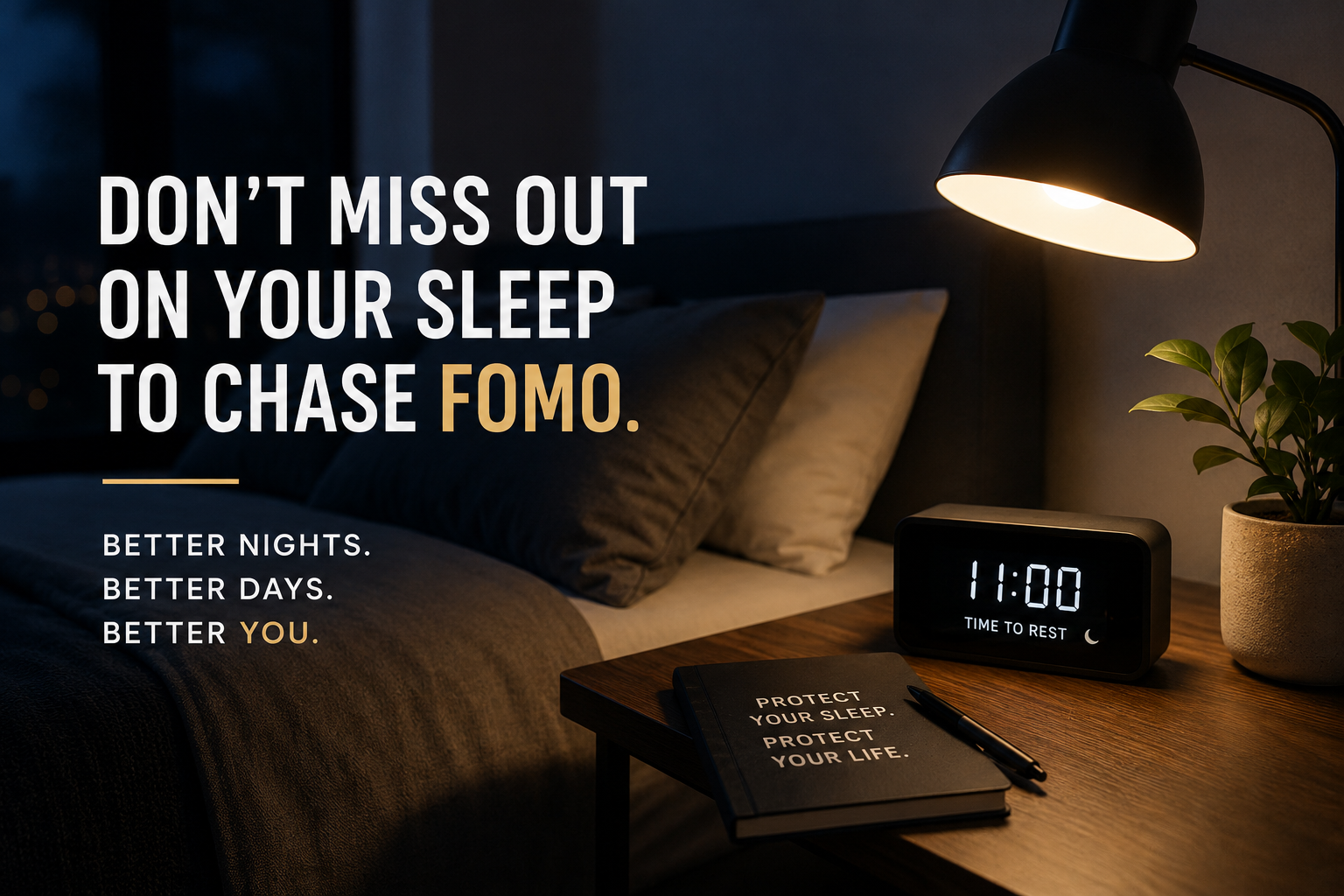
There is a particular kind of pressure that shows up when the night is going well. You have already been out for hours, everyone is talking about the next party, somebody mentions an after-party, and suddenly going home feels like giving up. Your brain starts telling you that something amazing might happen the second you leave. That is FOMO at work. The fear of missing out can convince you to ignore the fact that you are exhausted, overstimulated, and no longer even having that much fun.
The problem is that FOMO usually focuses only on what you might miss tonight. It rarely reminds you what you may be sacrificing tomorrow. Another few hours out can mean much less sleep, worse concentration, irritability, lower energy, more anxiety, and an entire next day spent trying to recover. Sometimes staying out feels worth it in the moment because the cost does not arrive until later.
This is where it can help to ask yourself a simple question: am I actually still enjoying myself, or am I staying because I am afraid to leave? Those are very different things. If you are genuinely having an incredible experience and occasionally decide to stay out late, that is one thing. But if you repeatedly stay out because you are afraid everyone else will have fun without you, FOMO may be making the decision instead of you.
Stop giving FOMO so much power over you. You do not have to attend every after-party. You do not have to be the last person standing. You do not have to squeeze every possible experience out of one night. There will be other parties, other trips, other weekends, and other opportunities. Going home does not automatically mean you missed out. Sometimes it means you recognized that you had already had enough and chose yourself.
Sleep is also more powerful when it is consistent. Your body does not just care about how many hours you sleep. It also responds to regularity. Going to bed around the same time as often as possible and waking up around the same time each day helps reinforce your natural sleep-wake rhythm. That consistency can make it easier to fall asleep, wake up, and feel more alert during the day.
This does not mean you need to become rigid about your bedtime or never stay out late again. Life happens. Vacations happen. Celebrations happen. Great nights happen. The goal is not perfection. The goal is to make consistency your default rather than treating sleep as the first thing you sacrifice whenever something more exciting appears.
Weekends can be particularly challenging because people often stay up several hours later and then sleep much later the following morning. That can make Monday feel almost like a miniature case of jet lag. If possible, try to keep your bedtime and wake time reasonably close to your normal schedule even when you are not working the next day. You can still have a social life without shifting your entire sleep schedule every weekend.
It can also help to stop thinking of sleep as the thing you do when everything else is finished. Sleep is not leftover time. It is part of the foundation that allows you to enjoy everything else more fully. When you are well rested, you are more likely to have the energy to exercise, work, socialize, travel, think clearly, regulate your emotions, and actually enjoy the next event instead of dragging yourself through it.
There is also something psychologically powerful about being able to leave when you are ready. You do not need everyone else to go home before you give yourself permission to leave. You can have an amazing night and still decide that midnight is enough. You can enjoy a party without needing to attend the after-party. You can be social without abandoning your own limits.
The fear underneath FOMO is often that life is happening somewhere else. Maybe the best conversation will happen after you leave. Maybe everyone will bond without you. Maybe something unforgettable will happen. Sometimes it will. You are going to miss things in life. That is unavoidable. The goal is not to experience everything. It is to choose the experiences that actually matter to you.
And sometimes what you are choosing is tomorrow morning.
You are choosing waking up rested instead of depleted. You are choosing your workout, your plans, your mood, your health, your relationships, and the version of yourself who does not need an entire day to recover from the night before.
That can be difficult when everyone around you is saying, “Come on, just one more place.” But protecting your sleep is not boring. It is a boundary. It is recognizing that your body has limits and that you do not have to override those limits simply because other people are still going.
Try deciding your cutoff time before you go out. If you already know that you want to be home around midnight, you are less likely to make the decision at 12:30 a.m. when you are tired, stimulated, and surrounded by people encouraging you to keep going. You can always make an exception for a truly special night, but exceptions work best when they remain exceptions.
It may also help to think beyond tonight. Ask yourself how you want to feel when you wake up tomorrow. If staying another three hours genuinely feels worth that tradeoff, make the choice consciously. But if you already know that you are going to regret it, listen to that part of yourself too.
A good life does not require maximizing every night. Sometimes the healthiest relationship with fun is knowing when you have had enough.
There will always be another party.
There will always be another invitation.
There will always be another opportunity to stay out later.
Your sleep, however, is happening tonight.
So enjoy yourself. Be spontaneous sometimes. Stay out late when the experience truly feels worth it. But as often as you reasonably can, give your body the consistency it needs. Go to bed around the same time. Wake up around the same time. Protect the routine that helps you function at your best.
Stop giving the fear of missing out the power to make every decision for you.
Sometimes going home is not missing out at all.
Sometimes it is choosing your sleep, your energy, your health, and yourself.